


Sausage Manufacturing Plant DPR & Unit Setup – 2026: Demand Analysis and Project Cost
- dorothypang12
- Apr 15
- 6 min read

Setting up a sausage manufacturing plant positions investors in one of the most dynamic and resilient segments of the global food processing industry. This growth is driven by rising consumer demand for convenience foods, increasing adoption of protein-rich diets, expansion of the foodservice sector, and the growing popularity of ready-to-eat meat products. As urban lifestyles become more fast-paced, consumers increasingly prefer quick-to-prepare foods that offer taste, convenience, and longer shelf life. In this context, understanding how to start a sausage manufacturing business is essential for evaluating production processes, market demand, and long-term profitability in this high-growth sector.
Market Overview and Potential Growth:
The global sausage market demonstrates a robust growth trajectory, valued at USD 49.60 Billion in 2025. According to IMARC Group’s comprehensive market analysis, the market is expected to reach USD 71.83 Billion by 2034, exhibiting a CAGR of 4.2% from 2026 to 2034. The market is primarily driven by the popularity of convenience, ready-to-cook and ready-to-eat protein-based meals, shifting lifestyles, urbanization, and the demands of the working-age population, who increasingly favor processed meat products with longer shelf life and quick preparation.
Sausage is a processed meat product made from ground or minced meat—such as pork, beef, or chicken—combined with salt, spices, and herbs for flavor. The mixture is typically filled into natural or synthetic casings and formed into links or rolls. Depending on processing methods and regional preferences, sausages can be fresh, cured, smoked, or fully cooked. They are widely consumed across various cuisines due to their rich taste, versatility, and ease of preparation. For entrepreneurs exploring opportunities in this segment, gaining clarity on how to start a sausage manufacturing operation helps in aligning production techniques with consumer preferences and regulatory requirements.
Modern sausage manufacturing includes a broad range of product categories such as fresh sausages, pre-cooked variants, smoked products, fermented or dry sausages, and plant-based alternatives. Market trends are being shaped by increasing demand for premium and artisanal products, ethnic varieties like chorizo, Italian sausage, and bratwurst, and healthier formulations with reduced fat and natural ingredients. The rapid expansion of fast-food chains, foodservice outlets, and street food culture further supports global consumption. Understanding how to start a sausage manufacturing business also involves selecting the right product mix and positioning strategy to cater to diverse consumer segments.
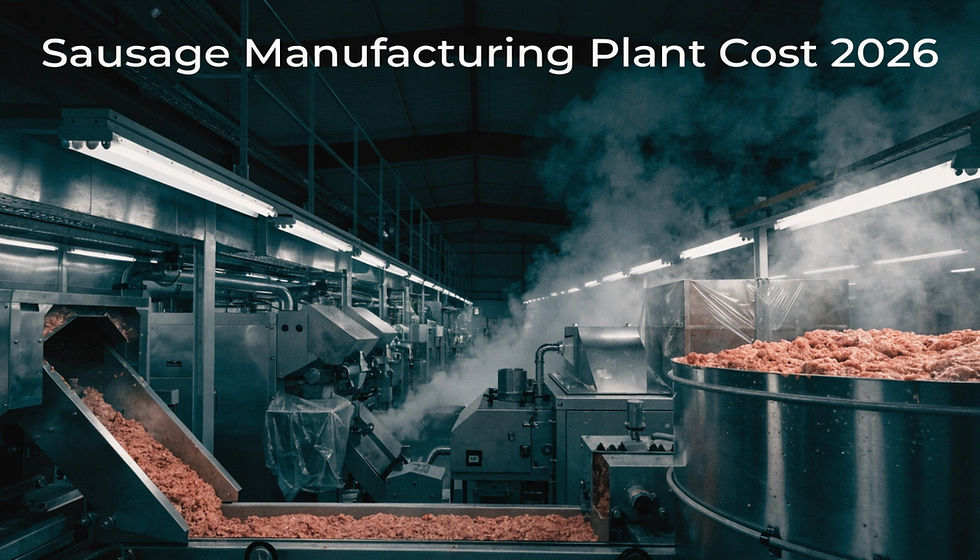
The global sausage market continues to grow steadily, supported by advancements in cold-chain logistics and expanding distribution channels including supermarkets, convenience stores, and e-commerce platforms. According to the Food and Agriculture Organization (FAO), global meat production exceeds 360 million tonnes annually, ensuring a strong supply base for large-scale processing. Given the infrastructure, hygiene standards, and processing equipment required, a detailed evaluation of how to start a sausage manufacturing plant is crucial for determining capital investment, operational efficiency, and sustainable growth in this established yet evolving food industry.
Plant Capacity and Production Scale:
The proposed sausage manufacturing facility is designed with an annual production capacity of 3,000 MT, enabling economies of scale while maintaining operational flexibility. This capacity allows producers to serve diverse market segments across retail, foodservice, hospitality, and processed foods—ensuring steady demand and consistent revenue streams driven by convenience food proliferation, urban population growth, increasing protein consumption, and applications in fresh, cooked, smoked, and plant-based sausage varieties.
Speak to an Analyst: https://www.imarcgroup.com/request?type=report&id=13078&flag=C
Financial Viability and Profitability Analysis:
The sausage manufacturing business demonstrates healthy profitability potential under normal operating conditions. The financial projections reveal:
• Gross Profit Margins: 25-35%
• Net Profit Margins: 12-20%
These margins are supported by stable demand across retail consumers, foodservice operators, processed food manufacturers, and hospitality sector buyers, value-added processing through automated grinding, mixing, stuffing, cooking, and packaging lines providing large-scale production while maintaining low per-unit costs, and the versatility of sausages serving as essential ingredients in retail, fast food, frozen meals, and ready-to-eat products delivering dependable performance with broad consumer appeal and consistent quality. The project demonstrates strong return on investment (ROI) potential with comprehensive financial analysis.
Cost of Setting Up a Sausage Manufacturing Plant:
Operating Cost Structure:
Understanding the operating expenditure (OpEx) is crucial for effective financial planning. The cost structure includes:
• Raw Materials: 75-80% of total OpEx
• Utilities: 5-10% of OpEx
• Other Expenses: Labor, packaging, transportation, maintenance, depreciation, taxes
Raw materials at 75–80% of operating costs, with meat (chicken/pork/beef) as the primary component, along with fat, spices, additives, and casing (natural or collagen). Utilities at 5–10%. By the fifth year, total operational cost expected to increase substantially due to inflation, market fluctuations, supply chain disruptions, rising consumer demand, and shifts in the global economy. Long-term contracts with reliable suppliers help stabilize pricing and ensure steady supply.
Capital Investment Requirements:
Setting up a sausage manufacturing plant requires substantial capital investment. The total depends on plant capacity, technology, and location.
Land and Site Development:
Location must offer easy access to key raw materials: meat (chicken/pork/beef), fat, spices, additives, and casing (natural or collagen). Proximity to target markets minimizes distribution costs. Robust infrastructure essential, including reliable transportation, utilities, and waste management systems. Compliance with local zoning laws and environmental regulations must also be ensured.
Machinery and Equipment:
Machinery costs account for the largest portion of total capital expenditure. Essential equipment includes:
• Meat grinders
• Mixers and blenders
• Stuffing machines
• Cookers and smokers
• Sausage casing machines
• Packaging lines
• Quality control systems
Civil Works:
Building construction, layout optimization. Separate areas for raw material storage, production (including grinding, mixing, stuffing, cooking, and packaging zones), quality control, refrigeration, and finished goods storage must be designated. Space for future expansion should be incorporated to accommodate business growth.
Buy Report Now: https://www.imarcgroup.com/checkout?id=13078&method=2175
Major Applications and Market Segments:
Sausages serve extensive applications across multiple consumer and commercial segments:
• Retail Consumers: The retail market is dominated by fresh, pre-cooked, and frozen sausages that cater to home cooking and convenience food trends including breakfast items, snacks, and quick weekday meals
• Foodservice and Hospitality: Sausages are widely used in restaurants, fast food chains, cafeterias, and catering services for quick and easy meal preparation
• Processed Foods and Ready-to-Eat Meals: Sausages are key ingredients in frozen meals, snack products, and ready-to-eat meal kits used in dishes like sausage rolls, pasta, sauces, and pre-cooked meal kits
• Vegetarian and Plant-Based Sausages: As consumer preferences shift toward plant-based diets, there is increasing demand for vegetarian and vegan sausages made from plant proteins like soy, pea, or seitan
Process: Meat selection and preparation, grinding, mixing and seasoning, stuffing, curing and smoking, cooking or drying, and packaging and labeling.
Why Invest in Sausage Manufacturing?
Compelling factors driving investment in sausage manufacturing:
✓ Growing Demand for Convenience Foods: As lifestyles become busier, consumers increasingly seek quick-to-prepare, easy-to-cook meals. Sausages, especially pre-cooked or frozen varieties, are perfectly suited for this demand, making them a staple in modern households and foodservice operations
✓ Health-Conscious and Dietary Trends: There is increasing preference for healthier sausages, such as low-fat, low-sodium, or plant-based options. Manufacturers are focusing on creating healthier formulations with natural ingredients and reduced additives to meet this growing consumer segment
✓ Premium and Ethnic Sausage Demand: Consumers are increasingly seeking premium, artisanal, and ethnic sausage products with unique flavors. This shift drives manufacturers to innovate with new flavor profiles, spices, and international varieties like chorizo, Italian sausages, and Bratwurst
✓ Sustainability and Plant-Based Alternatives: With growing interest in plant-based diets and sustainability, demand for vegetarian and vegan sausages is rapidly expanding. Producers are exploring alternative proteins including peas, lentils, and soy to cater to health-conscious and environmentally aware consumers
✓ Scalable High-Volume Production: Automated grinding, mixing, stuffing, cooking, and packaging lines enable large-scale production while maintaining consistent quality with competitive manufacturing costs
Manufacturing Process Excellence:
The sausage manufacturing process is a multi-step operation involving:
• Meat selection and preparation
• Grinding and size reduction
• Mixing and seasoning with spices, additives, and fat
• Stuffing into natural or synthetic casings
• Curing and smoking (for applicable product types)
• Cooking or drying to required internal temperature or moisture level
• Chilling and packaging
• Quality inspection, marking, and labeling
Comprehensive quality control is maintained throughout production. Analytical instruments monitor product concentration, purity, internal temperature, pH, and stability. Documentation for traceability and regulatory compliance must be maintained throughout the production lifecycle.
Industry Leadership:
Leading manufacturers in the global sausage industry include several multinational companies with extensive manufacturing capacities and diverse application portfolios. Key players include:
• Tyson Foods, Inc.
• JBS S.A.
• Smithfield Foods (WH Group)
• Hormel Foods Corporation
• OSI Group
• Danish Crown (Tulip Food Company A/S)
• Pilgrim’s Pride Corporation
All serve end-use sectors such as foodservice and hospitality, and processed foods.
About Us:
IMARC Group is a global management consulting firm that helps the world’s most ambitious changemakers to create a lasting impact. The company excels in understanding its client’s business priorities and delivering tailored solutions that drive meaningful outcomes. We provide a comprehensive suite of market entry and expansion services. Our offerings include thorough market assessment, feasibility studies, company incorporation assistance, factory setup support, regulatory approvals and licensing navigation, branding, marketing and sales strategies, competitive landscape and benchmarking analyses, pricing and cost research, and procurement research.
Contact Us:
IMARC Group
134 N 4th St. Brooklyn, NY 11249, USA
Email: sales@imarcgroup.com
Tel No: (D) +91 120 433 0800
United States: (+1-201-971-6302)


Comments