


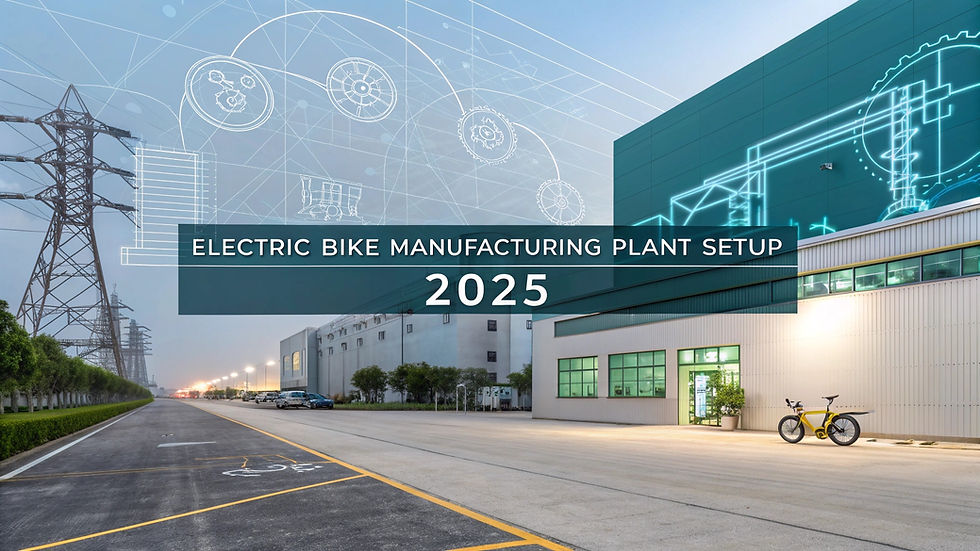
Electric Bike Manufacturing Plant Project Report 2025: Raw Materials, Infrastructure & Cost Analysis
- yogeshimarc
- Oct 13, 2025
- 5 min read

IMARC Group’s report, “Electric Bike Manufacturing Plant Project Report 2025: Industry Trends, Plant Setup, Machinery, Raw Materials, Investment Opportunities, Cost and Revenue,” offers a comprehensive guide for establishing a manufacturing plant. The electric bike manufacturing plant setup cost report offers insights into the manufacturing process, financials, capital investment, expenses, ROI, and more for informed business decisions.
Electric Bike Manufacturing Plant Project Report Summary: -
Comprehensive guide for setting up an electric bike manufacturing plant.
Covers market trends and industry outlook for 2025.
Detailed project setup, including unit operations and processes.
Raw material and utility requirements.
Infrastructure and machinery specifications.
Workforce and staffing requirements.
Packaging and transportation details.
Financial aspects: investment opportunities, cost analysis, and revenue projections.
In addition to covering operational aspects, the report offers detailed insights into the electric bike manufacturing plant process and project economics.
Detailed insights into the electric bike manufacturing plant
In-depth project economics and financial metrics.
Covers capital investments and project funding.
Analysis of operating expenses and income projections.
Breakdown of fixed and variable costs, direct and indirect expenses.
Evaluation of ROI (Return on Investment) and NPV (Net Present Value).
Profit and Loss account analysis.
Comprehensive financial analysis for decision-making.
Provides a roadmap for successfully establishing an electric bike manufacturing.
Request for a Sample Report: https://www.imarcgroup.com/electric-bike-manufacturing-plant-project-report/requestsample
What is Electric Bike?
An electric bike, commonly known as an e-bike, is a bicycle that is powered by a small, rechargeable electric motor. It features an integrated motor that assists with pedaling, making it easier to ride, particularly on difficult terrains or long distances. It uses lithium-ion batteries, which are lightweight, efficient, and long-lasting. It can either have a pedal-assist system (PAS) or a throttle. It is equipped with high-performance disc brakes to ensure smooth and safe stopping power, especially at higher speeds. It can help reduce the number of cars on the road, easing congestion and shortening commute times for everyone. It has lower operational costs, as electricity is cheaper than gasoline, and e-bike maintenance is generally more affordable than maintaining a car.
Market Trends and Drivers:
The increasing global emphasis on sustainability and reducing carbon emissions is impelling the growth of the market. With growing concerns about climate change and pollution, many individuals and governments are actively seeking alternatives to conventional modes of transportation. E-bikes, which produce zero emissions and use electricity as their primary power source, present an attractive solution. Unlike cars and motorbikes, e-bikes do not rely on fossil fuels, making them a sustainable option for short-distance travel in urban areas. As cities and countries implement stricter environmental policies, the demand for eco-friendly transportation options like e-bikes is rising. Technological improvements are supporting the market growth. Apart from this, advancements in battery technology, motor efficiency, and lightweight materials are making e-bikes more affordable, durable, and reliable. Lithium-ion batteries, which are commonly used in e-bikes, are becoming more energy-dense, offering greater range with shorter charging times. Additionally, manufacturers are now developing more efficient motors that provide smoother, quieter rides, improving the overall cycling experience. Battery life is improving significantly, with some modern e-bikes capable of covering distances between 50 to 100 miles on a single charge, making them viable options for longer commutes. These technological improvements are expanding the appeal of e-bikes beyond recreational use, positioning them as a practical, everyday alternative to traditional vehicles.
Key Insights Covered in the Electric Bike Manufacturing Plant Report
Market Coverage:
Market Trends: Analysis of current and emerging trends in the electric bike market.
Market Segmentation: Breakdown of the market by different segments.
Regional Analysis: Distribution and performance of the market across various regions.
Price Analysis: Evaluation of pricing trends for agricultural battery sprayer.
Impact of COVID-19: Examination of the effects of the COVID-19 pandemic on the Electric bike market.
Market Forecast: Outlook and projections for the electric bike industry.
Key Aspects Required for Setting Up an Electric Bike Plant
Detailed Process Flow:
Product Overview: Comprehensive description of the electric bike product and its characteristics.
Unit Operations Involved: Step-by-step breakdown of the various operations in the production process.
Mass Balance and Raw Material Requirements: Calculations for material inputs and outputs, along with required quantities of raw materials.
Quality Assurance Criteria: Standards and procedures to ensure the quality of the final product.
Technical Tests: Essential tests and evaluations to maintain product consistency and compliance.
Project Details, Requirements, and Costs Involved
Land, Location, and Site Development: Assessment of land requirements, optimal location selection, and site development costs.
Plant Layout: Design and layout planning for efficient plant operations.
Machinery Requirements and Costs: Identification of machinery needed, along with the associated costs.
Raw Material Requirements and Costs: Determination of the types and quantities of raw materials required and their costs.
Packaging Requirements and Costs: Specifications for packaging materials and equipment, including associated expenses.
Transportation Requirements and Costs: Logistics planning and cost estimation for the transportation of raw materials and finished products.
Utility Requirements and Costs: Analysis of utility needs (such as water, electricity, and fuel) and their associated costs.
Human Resource Requirements and Costs: Workforce planning, including staffing needs, roles, and costs for labor and management.
Project Economics
Capital Investments: Initial costs required for setting up the electric bike manufacturing plant, including land, equipment, and infrastructure.
Operating Costs: Ongoing expenses for running the plant, such as raw materials, labor, utilities, and maintenance.
Expenditure Projections: Detailed forecasts of all costs over the short and long term.
Revenue Projections: Expected income generated from the sale of electric bike and by-products.
Taxation and Depreciation: Analysis of tax obligations, incentives, and asset depreciation over time.
Profit Projections: Estimated profitability based on costs, revenues, and market conditions.
Financial Analysis: Comprehensive evaluation of the plant’s financial viability, including cash flow analysis, return on investment (ROI), and break-even point.
Ask Analyst for Customization: https://www.imarcgroup.com/request?type=report&id=19347&flag=C
Customization Options Available:
Plant Location: Selection of optimal location for the plant.
Plant Capacity: Customization based on desired production capacity.
Machinery: Choice between automatic, semi-automatic, or manual machinery.
List of Machinery Providers: Identification of suitable machinery suppliers.
Key Questions Addressed in This Report:
· How has the electric bike market performed so far and how will it perform in the coming years?
· What is the market segmentation of the global electric bike market?
· What is the regional breakup of the global electric bike market?
· What are the price trends of various feedstocks in the electric bike industry?
· What is the structure of the electric bike industry and who are the key players?
· What are the various unit operations involved in an electric bike manufacturing plant?
· What is the total size of land required for setting up an electric bike manufacturing plant?
· What is the layout of an electric bike manufacturing plant?
· What are the machinery requirements for setting up an electric bike manufacturing plant?
· What are the raw material requirements for setting up an electric bike manufacturing plant?
· And more…
How IMARC Can Help?
IMARC Group is a global management consulting firm that helps the world’s most ambitious changemakers to create a lasting impact. The company provide a comprehensive suite of market entry and expansion services. IMARC offerings include thorough market assessment, feasibility studies, company incorporation assistance, factory setup support, regulatory approvals and licensing navigation, branding, marketing and sales strategies, competitive landscape and benchmarking analyses, pricing and cost research, and procurement research.
Services:
Plant Setup
Factoring Auditing
Regulatory Approvals, and Licensing
Company Incorporation
Incubation Services
Recruitment Services
Marketing and Sales
Contact Us:
IMARC Group
134 N 4th St. Brooklyn, NY 11249, USA
Email: sales@imarcgroup.com
Tel No:(D) +91 120 433 0800
United States: +1-201971-6302



Comments