


Breadfruit Processing Plant (DPR) 2026: Raw Materials Cost and Unit Setup
- dorothypang12
- Apr 6
- 6 min read

Setting up a breadfruit processing plant positions investors in one of the most compelling and high-potential segments of the global tropical food value chain, backed by sustained growth driven by rising demand for gluten-free and plant-based foods, increasing adoption of breadfruit flour in bakery and snack applications, growing awareness of breadfruit's nutritional benefits, and expanding food security initiatives in tropical regions worldwide. As consumers globally accelerate their shift toward sustainable, climate-resilient food sources, and food manufacturers integrate more nutritious tropical ingredients into their product ranges, the breadfruit processing industry continues to present compelling opportunities for entrepreneurs and agribusinesses seeking long-term profitability in a high-demand sector.
Market Overview and Potential Growth:
The global breadfruit market size was valued at USD 354.20 Million in 2025. According to IMARC Group estimates, the market is expected to reach USD 656.68 Million by 2034, exhibiting a CAGR of 7.1% from 2026 to 2034. The market is primarily driven by rising demand for gluten-free and plant-based food alternatives, growing food security initiatives in tropical regions, increasing popularity of breadfruit flour in bakery applications, and expanding consumer awareness of its superior nutritional profile.
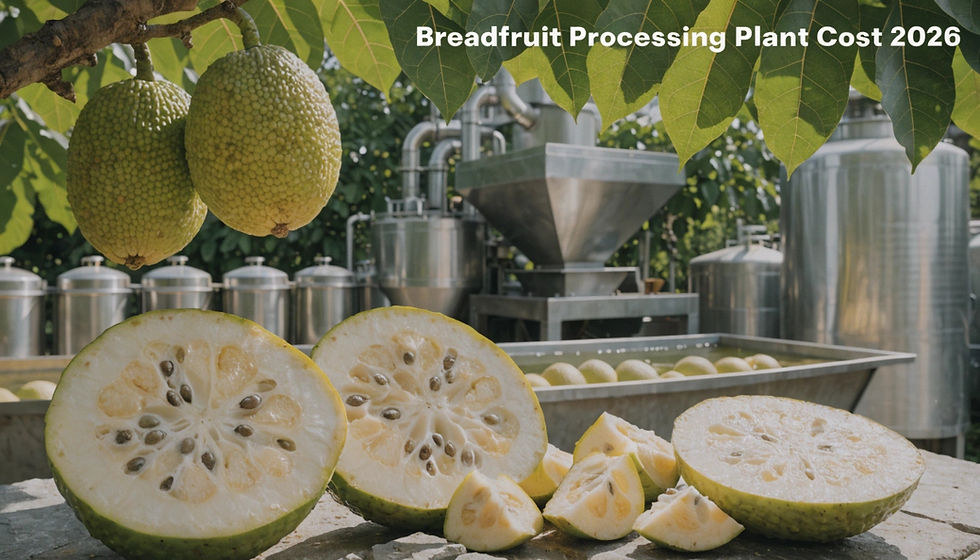
Breadfruit (Artocarpus altilis) is a tropical fruit from the Moraceae family, native to the Pacific Islands and widely cultivated across tropical and subtropical regions. It is valued for its starchy, potato-like texture when cooked and its high nutritional content, making it an important staple food in many communities. The name “breadfruit” comes from the bread-like consistency of its cooked flesh. It can be consumed in various forms—boiled, roasted, fried, or processed into flour for baking. The breadfruit tree is low-maintenance, highly productive, and climate-resilient, typically yielding between 50 to 200 fruits annually depending on growing conditions, which makes it a significant crop for food security and sustainable agriculture.
Modern breadfruit processing includes fresh distribution as well as value-added products such as dried slices, canned goods, breadfruit flour, chips, snacks, and ready-to-eat meals, catering to diverse consumer segments across retail, foodservice, and industrial markets. Breadfruit flour, in particular, has gained strong traction due to its gluten-free nature and rich nutritional profile, including carbohydrates, dietary fiber, potassium, and vitamin C. This has led to increased adoption in bakery and specialty food applications. As a result, the processed breadfruit segment is projected to grow at a CAGR of around 6.2%, driven by rising consumer demand for convenient and nutritious food alternatives.
The breadfruit market is witnessing steady growth due to increasing health awareness and the expanding demand for gluten-free products across global markets. Governments and development organizations are also promoting breadfruit cultivation as a sustainable and climate-resilient solution to enhance food security in tropical regions. For example, countries like Jamaica have seen rising production and export volumes, supported by growing international demand. As food processors continue to explore new product innovations, understanding how much does it cost to start a breadfruit processing plant becomes a key consideration for investors and entrepreneurs aiming to capitalize on this emerging and versatile food processing segment.
Plant Capacity and Production Scale:
The proposed breadfruit processing facility is designed with an annual production capacity ranging between 500 MT - 5,000 MT of processed breadfruit products, enabling economies of scale while maintaining operational flexibility. This capacity range allows processors to serve diverse market segments across food manufacturing, retail, food service, and export — ensuring steady demand and consistent revenue streams driven by gluten-free product proliferation, food security initiatives, health-conscious consumer adoption, and applications in flour milling, snack production, canning, drying, and ready-to-eat meal preparation.
Speak to an Analyst: https://www.imarcgroup.com/request?type=report&id=10895&flag=C
Financial Viability and Profitability Analysis:
The breadfruit processing business demonstrates healthy profitability potential under normal operating conditions. The financial projections reveal:
• Gross Profit Margins: 25-35%
• Net Profit Margins: 12-22%
These margins are supported by stable demand from food manufacturers, specialty retailers, food service operators, and export distributors; value-added processing through milling, drying, canning, and packaging lines providing large-scale production while maintaining low raw material input costs; and the critical importance of breadfruit as a versatile, nutritious, and climate-resilient tropical food commodity delivering dependable performance with strong consumer appeal and meeting growing global requirements for sustainable, gluten-free food ingredients. The project demonstrates strong return on investment (ROI) potential with comprehensive financial analysis.
Cost of Setting Up a Breadfruit Processing Plant:
Operating Cost Structure:
Understanding the operating expenditure (OpEx) is crucial for effective financial planning. The cost structure includes:
• Raw Materials: 55-65% of total OpEx
• Utilities: 12-18% of OpEx
• Other Expenses: Labor, packaging, transportation, maintenance, depreciation, taxes
Raw materials at 55-65% of operating costs, with fresh breadfruit as the primary input, along with packaging materials, preservatives, processing chemicals, and secondary ingredients. Utilities at 12-18%, covering electricity for processing equipment, refrigeration, water supply, and waste management systems. By the fifth year, total operational costs are expected to increase substantially due to inflation and market fluctuations. Long-term contracts with reliable tropical fruit suppliers help stabilize pricing and ensure steady supply throughout the season.
Capital Investment Requirements:
Setting up a breadfruit processing facility requires substantial capital investment. The total investment depends on plant capacity, technology level, and location.
Land and Site Development: Location must offer access to key raw material supply zones in tropical breadfruit-producing regions. Proximity to target markets minimizes distribution costs. Adequate water supply and waste treatment infrastructure are essential.
Machinery and Equipment: Machinery costs account for the largest capital portion. Essential equipment includes:
• Washing and cleaning systems
• Peeling and slicing machinery
• Blanching and drying units
• Milling and flour processing equipment
• Canning and sealing lines
• Cold storage and refrigeration systems
• Packaging lines
Civil Works: Building construction and layout optimization. Separate areas required for fresh produce intake, raw material storage, processing, quality control, cold storage, and finished goods warehousing.
Buy Report Now: https://www.imarcgroup.com/checkout?id=10895&method=2175
Major Applications and Market Segments:
Breadfruit and its processed derivatives serve extensive applications:
• Food & Beverages: Breadfruit flour used in gluten-free breads, tortillas, pancakes, and baked goods; fresh and canned breadfruit in ready-to-eat meals and restaurant menus
• Bakery & Snacks: Processed breadfruit chips, crackers, and specialty snacks capitalizing on the rapidly growing gluten-free snack market, with over 25% of new product launches incorporating breadfruit flour in 2023
• Animal Feed: Breadfruit residues and by-products used as nutritious animal feed in tropical agricultural regions
• Pharmaceuticals & Cosmetics: Breadfruit leaf and seed extracts utilized for their antioxidant, anti-inflammatory, and skin-nourishing properties in personal care and nutraceutical formulations
Process overview: Fresh fruit intake and grading, washing and surface treatment, peeling and core removal, slicing or milling, blanching, drying or canning, quality control testing, packaging, and cold chain distribution.
Why Invest in Breadfruit Processing?
Compelling investment factors include:
• Rapidly Growing Gluten-Free Market: The global gluten-free market's robust expansion directly drives demand for breadfruit flour as a premium natural alternative, with the breadfruit flour segment alone projected to grow from USD 120 million in 2025 to USD 346.9 million by 2035 at a CAGR of 11.2%
• Climate Resilience and Sustainability: Breadfruit is recognized globally as a climate-resilient crop with minimal agricultural inputs, making it highly attractive as sustainability concerns drive sourcing decisions across global food companies
• Food Security Initiative Alignment: Governments and NGOs in tropical regions are actively investing in breadfruit cultivation and processing infrastructure, creating supportive regulatory and funding environments for new processing ventures
• Versatility Across Product Categories: Breadfruit's adaptability — from fresh distribution to flour, chips, canned goods, and extracts — enables processors to diversify revenue streams and serve multiple market segments simultaneously
• Expanding Export Opportunities: North American and European markets are experiencing strong demand growth for tropical, gluten-free food ingredients, creating significant export revenue potential for well-positioned breadfruit processing plants
Manufacturing Process Excellence:
The breadfruit processing operation follows a rigorous multi-step workflow:
• Incoming fruit inspection, grading, and quality assessment
• Washing, sanitization, and surface cleaning
• Mechanical or manual peeling and core/seed removal
• Slicing, chopping, or grinding depending on end product
• Blanching for enzyme inactivation and preservation
• Drying (solar, forced air, or freeze-drying), canning, or milling to flour
• Packaging under controlled atmosphere or vacuum sealing
• Final quality inspection, labeling, and cold chain dispatch
Comprehensive quality control is maintained throughout production. Analytical instruments monitor moisture content, microbial load, nutritional profile, texture, and shelf-life stability in compliance with international food safety standards.
Industry Leadership:
Leading companies in the breadfruit market include:
• M. Levin & Co (USA)
• Tropical Fruit Company (Netherlands)
• Hawaii Ulu Cooperative (USA)
• Carita Jamaica Ltd. (Jamaica)
• JAECo Ltd (Jamaica)
• Maui Breadfruit Company (USA)
• Livys Food Ltd. (USA)
All serve end-use sectors including food manufacturing, specialty retail, food service, export trade, and pharmaceutical/cosmetic ingredient supply.
About Us:
IMARC Group is a global management consulting firm that helps the world's most ambitious changemakers to create a lasting impact. The company excels in understanding its client's business priorities and delivering tailored solutions that drive meaningful outcomes. We provide a comprehensive suite of market entry and expansion services. Our offerings include thorough market assessment, feasibility studies, company incorporation assistance, factory setup support, regulatory approvals and licensing navigation, branding, marketing and sales strategies, competitive landscape, and benchmarking analyses, pricing and cost research, and procurement research.
Contact Us:
IMARC Group
134 N 4th St. Brooklyn, NY 11249, USA
Email: sales@imarcgroup.com
Tel No: (D) +91 120 433 0800
United States: (+1-201-971-6302)


Comments